

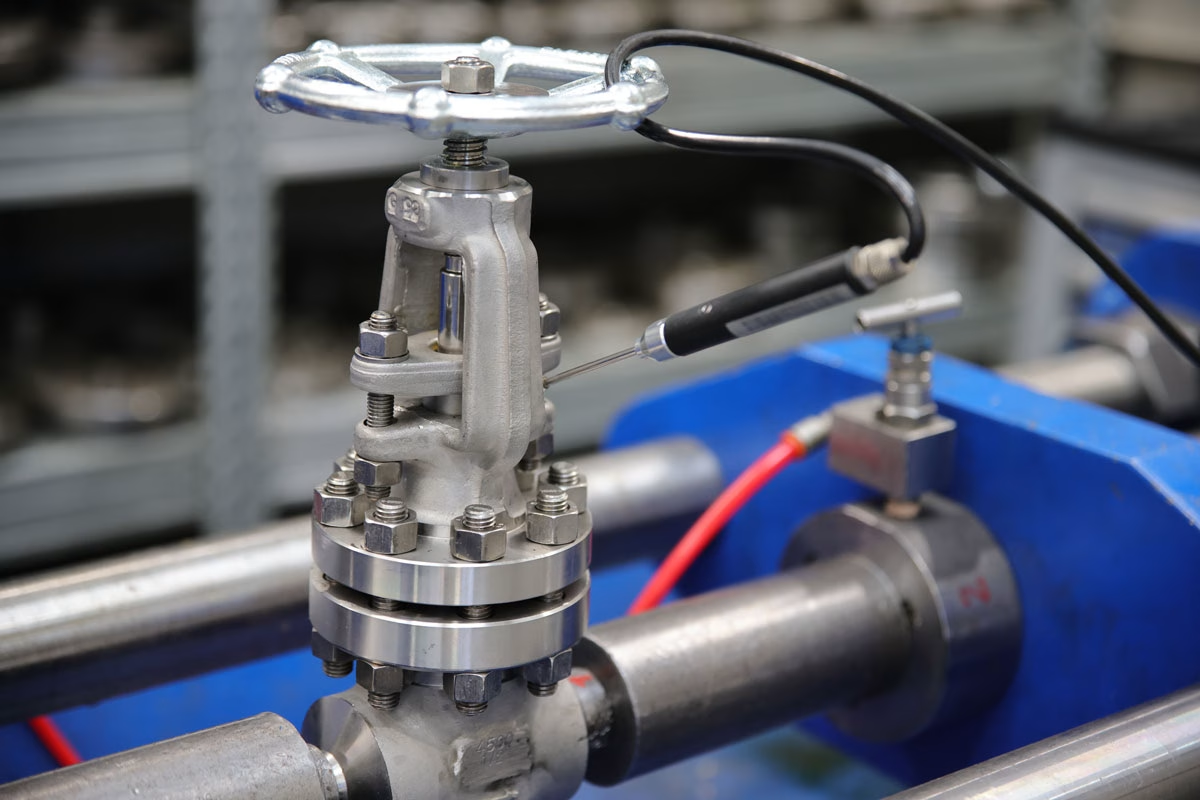
In the world of industrial valves, fugitive emissions are not a minor detail. They are a technical requirement that impacts HSE, plant reliability, operational continuity and, increasingly, project specifications. This is why many requests for quotations explicitly include low-emission valves or design solutions aimed at reducing external leaks.
For MTM Valves, this issue translates into a concrete approach: analysis of operating conditions, choice of materials, definition of packing and testing consistent with the project objective.
1. Why fugitive emissions are an HSE issue and not just an environmental one
Fugitive emissions are unintentional releases of gases or vapours into the environment. In the field, they often do not present themselves as obvious leaks: they can be stable micro-leaks over time or phenomena that appear after thermal cycles, repeated manoeuvres, vibrations or mechanical adjustments. From an HSE perspective, there are two critical issues: potential exposure and difficulty in early detection.
When the plant works with critical fluids (hazardous, aggressive, highly permeable or simply expensive), prevention also involves the correct selection of the valve and, above all, its seals.
2. The key point: low emission packing
In most cases, the source of the problem is the valve stem seal. The packing must provide an effective barrier under real conditions: pressure, temperature, opening/closing cycles, operating frequency and possible vibrations.
When it comes to low emission valves, it is important to clarify a point that is often misunderstood: it is not enough to choose “a good material”. Low emission packing only delivers the expected results if it is carefully designed, correctly installed and combined with a stem with suitable surface finishes and tolerances.
3. Bellow seal valve: when it makes sense to use it
In some applications, the most effective solution for reducing external leakage is the bellow seal valve. The principle is simple: the bellows create a metal barrier between the process fluid and the stem area, drastically reducing the possibility of emissions through the traditional seal.
That said, the bellows seal is not ‘universal’: it should be chosen when the operating profile, operating cycles and temperature/pressure conditions make this design the most suitable. MTM Valves supports case-by-case evaluation, because the goal is not only to reduce emissions, but also to ensure the overall durability and reliability of the valve.
Reducing emissions means designing the seal, not ‘adding an option’.
Fugitive emissions in valves are controlled through design choices and consistent checks: packing, stem, preloads, assembly and, where necessary, constructions such as bellow seal valves. MTM Valves works alongside customers and designers to define the most suitable solution for the service, using a method that integrates technical analysis and dedicated testing.
Contact us to discuss your plant requirements and find out which low emission valve is best suited to your needs.