

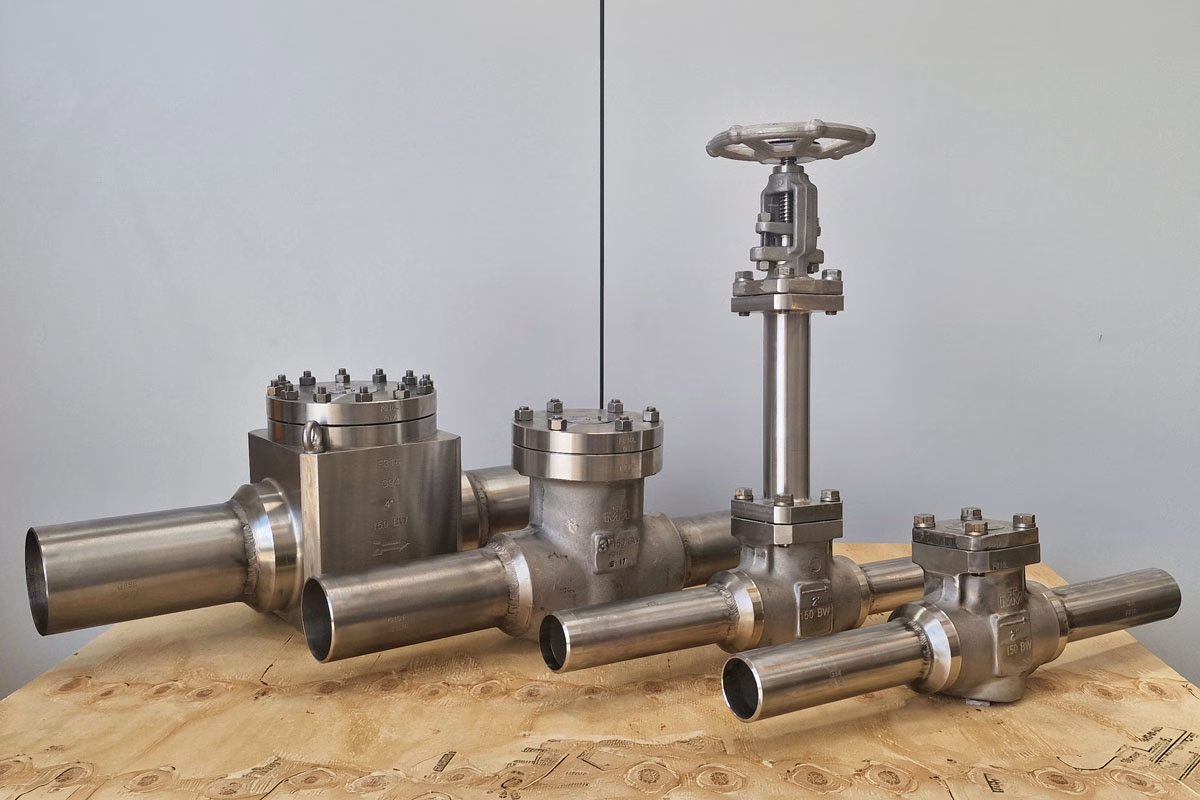
In the LNG industry, cryogenic valves are critical components: they must maintain reliability, maneuverability, and tightness even under very low temperatures and thermal transitions. Therefore, the selection of LNG cryogenic valves requires a structured approach, combining material selection, seal configuration, and a test plan consistent with operating conditions.
MTM Valves develops forged valves and, in cryogenic applications, supplements the design with dedicated inspection plans, making commissioning easier and ensuring consistent performance over time.
1. What does “cryogenic” mean in an LNG plant.
In LNG, “cryogenic” is not just a temperature value-it is a set of conditions that affect material behavior.
Thermal contraction, preload variations, and duty cycles affect various aspects of the valve, from the sliding and maneuverability of the stem, to the seal to the outside (packing) and between the body and the bonnet, to the seat seal.
For this reason, a cryogenic valve for LNG must be evaluated considering both its behaviour under steady-state conditions and variable operating conditions, including temperature variations.
2. Cryogenic valve materials: selection and compatibility
The choice of materials for cryogenic valves is one of the first technical steps. In low-temperature operation, in addition to mechanical strength, the following factors become crucial:
- Low temperature behavior (toughness and stability)
- Compatibility with the fluid and any aggressive conditions
- Consistency between forged body, trim, and sealing surfaces
On this basis, MTM Valves supports the definition of material combinations consistent with the pressure and temperature conditions and with the plant maintenance philosophy, focusing on solutions designed for actual operating conditions.
3. Cryogenic sealing: stem, packing and stability over time
Cryogenic sealing depends significantly on the construction precision, tolerance control and assembly quality. At low temperatures, even minimal variations can result in performance differences, especially after thermal cycles or repeated manoeuvres.
The main aspects to consider are:
- packing and configuration: materials and geometries must be compatible with low temperatures and cycles, maintaining stable behaviour
- stem finish and geometry: roughness, concentricity and treatments directly affect the efficiency of the seal and its wear
In an LNG plant, seal evaluation is not only about the absence of initial leaks, but also about repeatability over time under variable conditions.
4. Configuration and functionality: performance and manoeuvrability
In cryogenic valves, manoeuvrability is an integral part of performance. Friction, dimensional variations and environmental conditions can affect valve response and field management.
For this reason, the configuration of an LNG cryogenic valve also takes into account:
- possibility of installation of actuators or gearboxes
- protection and stability of control organs
- installation conditions and maintenance constraints
The goal is to achieve a valve that maintains stable performance and controllability without requiring unplanned maintenance work.
5. Cryogenic -196°C test: role of testing and verification criteria
Cryogenic testing at -196°C (or equivalent tests included in the design) is among the tests used to validate performance under severe conditions. In a structured course, testing is used to confirm consistency between configuration, materials, and sealing objective.
A well-set evidence plan clarifies:
- test conditions and sequences (temperature, pressure, duration)
- Acceptance criteria (tightness, stability, maneuverability)
- required reporting (traceability, instruments, results)
MTM Valves integrates testing into the production and quality control process with the aim of providing clear and fully documentable validation, for example in accordance with BS 6364 or ISO 28921.